Tracking AI citation patterns across sponsored and non-sponsored AFAR articles.
The question
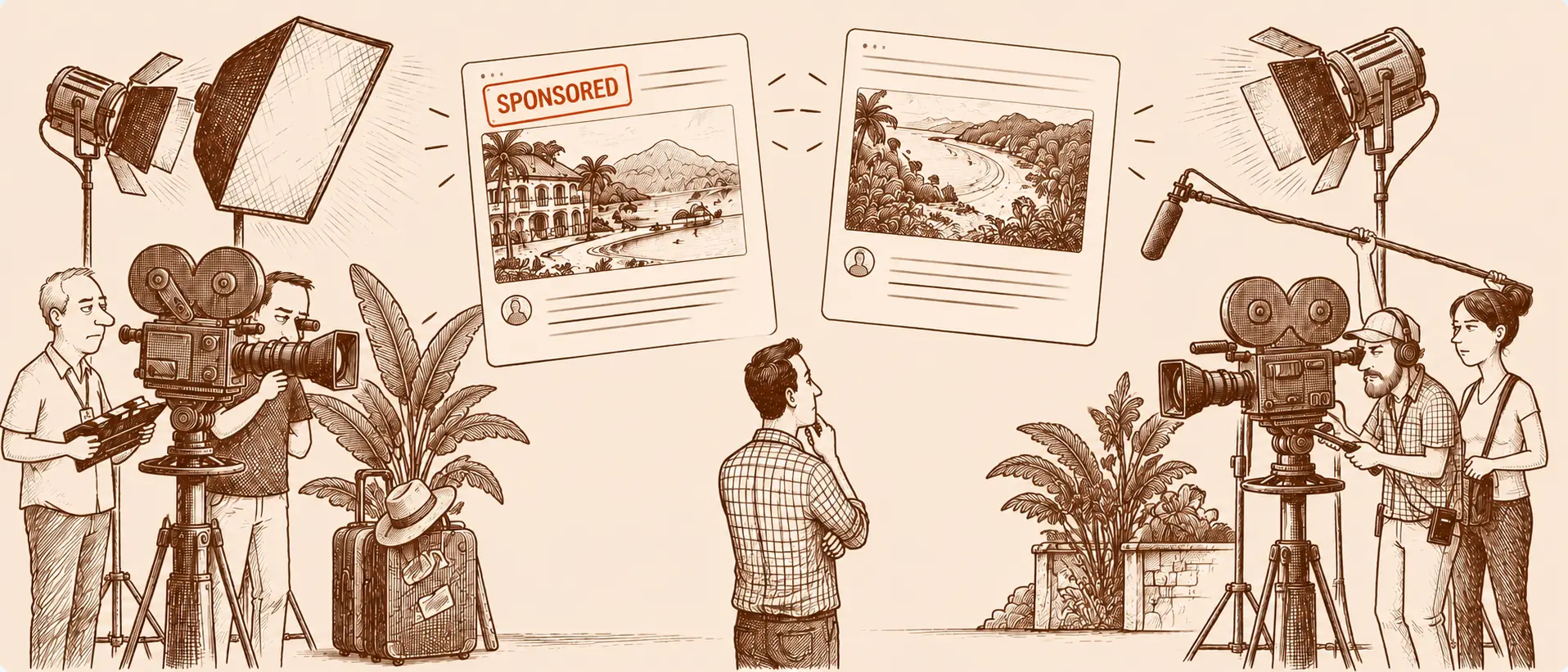
Sponsored content is often assumed to carry less editorial credibility. But does that distinction influence which travel stories AI assistants choose to cite?
NUNO partnered with AFAR to examine sponsored and non-sponsored articles and investigate whether sponsorship was associated with a lower likelihood of receiving an AI citation.
What we investigated
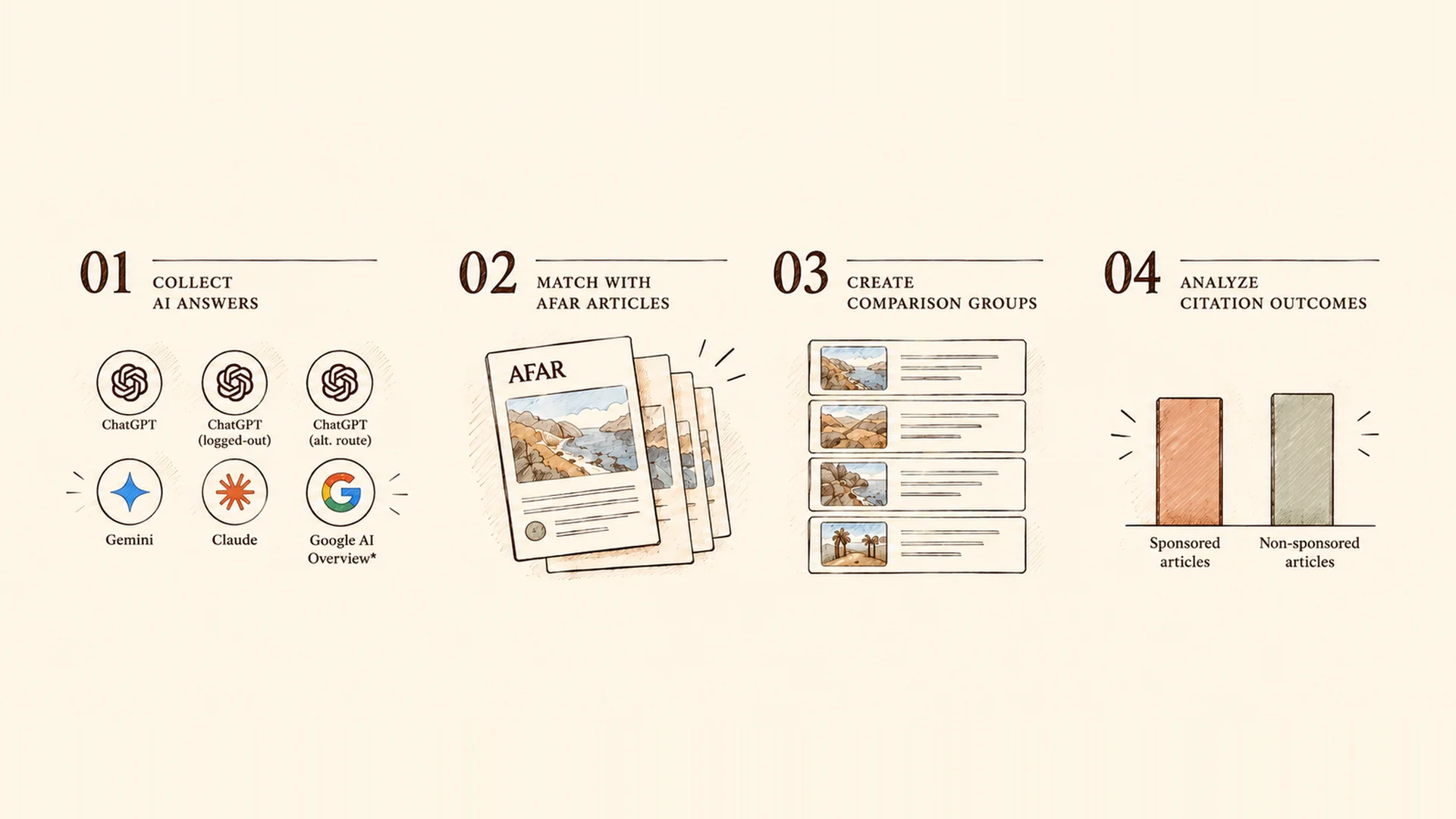
Between July 1 and September 8, 2026, NUNO collected close to 200,000 AI-generated answers to nearly 3,000 travel queries from six sources and collection routes: ChatGPT (one logged-in route and two logged-out routes), Claude, Gemini, and Google AI Overview.
We compared these answers with AFAR's article inventory, checking each article's sponsorship status and whether it was cited. Comparing raw citation totals would have been misleading, because a hotel story and a restaurant guide may attract different attention simply because they answer different questions, not because one is sponsored.
To create a more meaningful comparison, we identified articles in the same content category as each cited article, published before the query's first recorded answer. We then selected up to five comparison articles using query terms and textual similarity.
From AI answers to a fair comparison
The main analysis included over 350,000 response–article opportunities, drawn from over 41,000 eligible answers, close to 750 traveler search queries, and 2,022 distinct AFAR articles.
Each opportunity measured whether a candidate article was cited in a particular AI-generated answer. This allowed us to compare citation outcomes by sponsorship status while accounting for differences across queries and AI sources.
What we found
Sponsored articles: 1.1%
Non-sponsored articles: 1.1%
Both figures are rounded to one decimal place and measured per response–article opportunity, rather than as a share of all AI answers.
After accounting for differences across queries and AI sources, the estimated sponsorship association was −0.1 percentage points. The result was not statistically significant (p = 0.708).
We also tested alternative matching criteria, query weights, sample restrictions, and individual AI sources. None identified a statistically significant sponsorship penalty at the 5% level.
Why it matters
For hotels and travel publishers, sponsored coverage has traditionally been evaluated through readership and brand exposure. AI citations introduce another dimension of visibility, as a travel story may be cited without the traveler ever visiting the original article. It was interesting to learn that, in the AFAR sample, sponsorship was not associated with a statistically significant citation disadvantage.
NUNO explores the distinction between paid visibility and AI citations in its analysis of paid media and AI discovery. The role of hotel differentiation in AI-assisted discovery is also explored in Nobody's Third Favorite Hotel.
What we still don't know
The findings are limited to AFAR articles and the queries examined. They cannot automatically be generalized to other publishers or AI systems.
The research was observational rather than experimental. Although the comparison method accounted for query relevance and content categories, it could not control for every difference in article quality, accessibility, age, or distribution. Cited articles were also newer on average than their matched counterparts.
The estimated 95% confidence interval ranged from approximately −0.7 to +0.5 percentage points, meaning the study cannot establish that sponsorship has exactly zero effect.
Recorded citations also do not reveal whether an AI system retrieved and rejected an article, influenced a recommendation, or contributed to a booking.
Beyond the sponsored label
The findings challenge the assumption that AI assistants necessarily discourage sponsored stories. A story that is relevant, well structured, and useful as a source does not appear to be held back simply because it was sponsored.
For hotels and travel publishers, the more useful question may be what makes a story worth citing, rather than how it was funded.
In this AFAR sample, sponsorship alone was not a statistically detectable disadvantage in earning an AI citation.
Read the Full Research
The complete study behind this article: the data, the comparison method and its limitations.